Run a REVS check before you pay for a used car.
Finance owing, written-off and stolen records, with the official PPSR certificate, in minutes.
Searching multiple databases. Please be patient.

The short answer
A REVS check is a search of the Personal Property Securities Register, the national register run by the Australian Financial Security Authority, for one vehicle, found by its number plate and state or by its 17-character Vehicle Identification Number. It tells you whether a security interest is registered against the car, which is the register's term for money owing on it. A car with a security interest can be repossessed from you even after you have paid the seller for it.
The same search brings back the national vehicle exchange's records as well: whether the car is recorded as written off or stolen, its make, model, colour and body type, and its registration plate and expiry. The result comes with a search certificate, the register's legal record of what was found on the day. RevsChecks runs that search by number plate and state, or by VIN, and emails you the report with the certificate attached as a PDF, from $7.90.
Sources: Personal Property Securities Register, do a used car or vehicle search and understand your car search result, both read 25 November 2026. RevsChecks is an independent search service. It is not the Australian Financial Security Authority, and this page is not the register.
What you get
The register's records, the exchange's records and the registration detail in one document, with the certificate attached.
Every security interest registered against the vehicle, with its registration number, start date and the secured party who claims to be owed the money. A clear result says so in the register's own words.
The write-off record from the exchange with its three codes translated into words: what caused it, where the damage was and how severe. Statutory and repairable write-offs are told apart.
Whether the car is recorded as stolen by a state or territory police force, and a plain statement when the exchange returned no stolen record.
The plate, the state and the registration expiry as held on the national exchange. A plate search uses this record to find the VIN, so the plate and the state are all you need to start.
Make, model, year, colour, body type, engine number and VIN, laid out to compare against the compliance plate and the papers of the car in front of you.
The register's search certificate attached to your email as a PDF with its search number, and 14 days of free rechecks: if the register changes, we email you.
What our own checks found
Of the vehicles checked through RevsChecks between 27 March 2022 and 21 November 2026:
By state, where enough vehicles were checked to say: in New South Wales 5.1% had a written-off record, 10.4% had money owing and 1.0% were recorded as stolen; in Queensland 14.1%, 9.8% and 2.8%; in Western Australia 20.1%, 11.4% and 1.5%. Other states are folded into the national figure.
These are vehicles someone chose to check before buying, usually because something made them cautious; they are not a sample of all Australian cars, and the figures say nothing about why. Method: the share of RevsChecks lookups with a found vehicle whose PPSR/NEVDIS response returned a written-off record, a registered security interest, or a stolen record, counted once per vehicle checked. Figures as at 25 November 2026; refreshed quarterly, next in February 2027.
See it before you buy it
Not a list of promises — this is a real section of a real RevsChecks report.
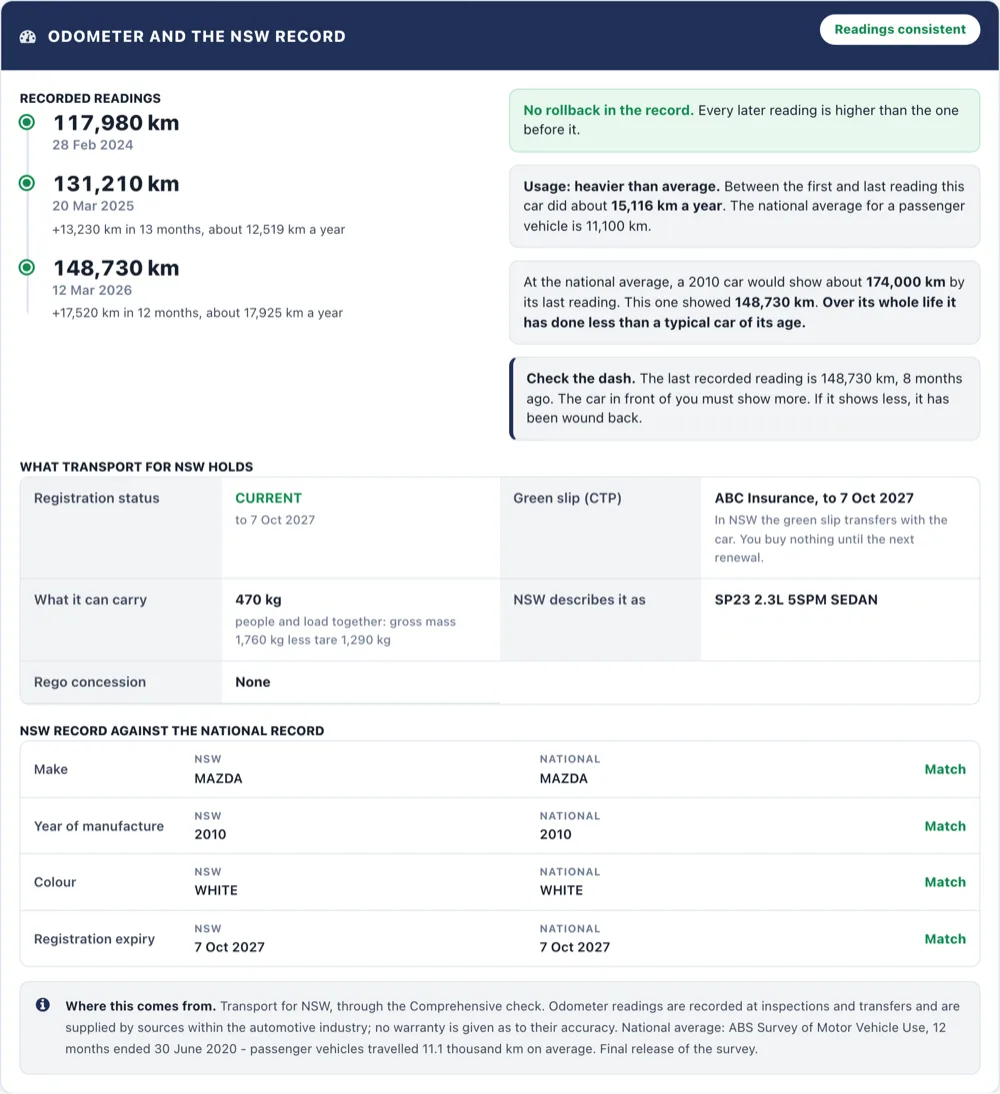
Three steps, no account, and the only personal detail is the email address the report goes to.
Type the number plate and the state it is registered in, or the 17-character VIN from the compliance plate or the papers.
The checkout shows what the report contains and the price before you pay: $7.90 by VIN, $9.90 by plate. Card or PayPal.
The report appears on screen and the email carries the register's certificate as a PDF with its search number.
Why here
$7.90 by VIN and $9.90 by plate, shown on the checkout before you pay. No subscription, no account, no upsell you did not ask for.
Every report carries the register's own search certificate as a PDF. It is your record of the search, and the search number on it can be verified at the register by anyone.
The report is on screen and in your inbox within minutes of payment, and the register is rechecked for 14 days at no charge. If a security interest is added or discharged, you hear about it.
RevsChecks is operated by Eprotech Pty Ltd, ABN 43 644 335 535, a registered PPSR account customer based in New South Wales. We are an independent search service, not a government agency. If you only want the register's own result and you already have the VIN, the register's own $2 search is the cheapest road; what it returns and what it does not is on our free and $2 checks page.
Read more
FAQs
The short answers.
A REVS check is a search of the Personal Property Securities Register and the national vehicle exchange for one vehicle, found by its number plate and state or by its 17-character Vehicle Identification Number. It tells you whether money is owing on the car, whether it is recorded as written off or stolen, and its registration detail, and it comes with the register's search certificate.
At the register itself, $2 online by VIN. Here, $7.90 by VIN and $9.90 by number plate and state, with the written-off codes in plain words, the registration detail, the stolen record and the official PPSR certificate attached as a PDF. The register cannot search a number plate.
Yes, here. Enter the number plate and the state it is registered in; the national exchange's registration record supplies the VIN and the search runs on it. The register's own site needs the VIN or chassis number.
On the compliance plate in the engine bay or on the driver's door pillar, on the registration certificate, and often at the base of the windscreen on the driver's side. It is 17 characters long and never contains the letters I, O or Q.
For a car, yes. A REVS check searched a state Register of Encumbered Vehicles. Those registers were replaced by the national Personal Property Securities Register on 30 January 2012, so a REVS check today is a PPSR search, with the written-off, stolen and registration detail added from the national exchange.
The report appears on screen after payment and the email with the certificate follows within minutes. It records the register on the day of the search, so run it on the day you buy or the day before; a RevsChecks report adds 14 days of free rechecks and emails you if the record changes.
Finance owing, written-off and stolen records, with the official PPSR certificate, in minutes.